Capacity expansion was the growth driver for the Bangladeshi garment industry for a long time and then came the era of building backward & forward linkages. But is this the answer to the increasing competition, not entirely, says Razzak Sattar, Managing Director, UTAH Group, comprising of spinning, knitting, weaving, sewing, washing and label manufacturing facilities all under one roof. Sattar believes in running his US $ 120 million business through 13 Key Performance Indicators (KPIs). “Now is the time to build systems, work on improving productivities and efficiencies for utilising existing resources. It’s about tracking and monitoring your losses more closely than profits because every saving is profit,” he says.
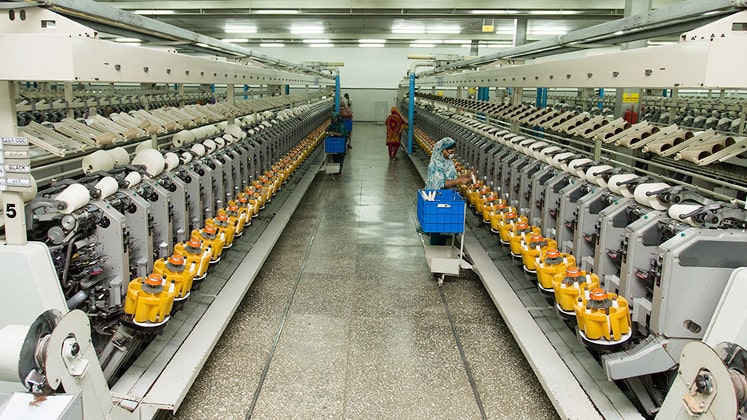
Managing a daily spinning capacity of 17 tonnes of yarn from 25,000 spindles, sewing 40,000 woven bottoms and 1,15,000 knit tops from 3,500 sewing machines, dyeing 18 tonnes of fabric, washing 25,000 garments, printing 40,000 garments and operating a temperature regulated warehouse to store dyestuffs and chemicals, requires a tight control on every process of apparel manufacturing, anything and everything which contributes to the quality and on-time delivery of the end-product. “Our focus on commitment can be judged by the fact that the UK-based retailer TESCO, who used to buy its corporate wear in red and blue colours from five apparel manufacturers all over the world, now buys it only from us,” shares Sattar, attributing this feat to his vertically integrated manufacturing setup governed by 13 Key Performance Indicators.
Shipping majority of its output to H&M, Tesco, Target, s.Oliver, Zara, New Look, Mango and Esprit, majorly European retailers and brands, Razzak Sattar believes that the next growth drivers for apparel manufacturers should be to cut on the wastages which greatly impact the profit margins. “I do not want to face Surplus, Air shipment and Discounts (SAD) in my business, for which I monitor 13 KPIs,” asserts Sattar, who wishes to change the mindset of the production people in his factory to not cut more than 2% excess fabric by monitoring KPIs.
| UTAH Group’s Operational Performance Measurement for 2014 | |||
| Sl. No. | Key Performance Indicators | Target | Achieved |
| 1 | Defects Per Hundred Units | 2 | 3 |
| 2 | First Time Through | 98% | 96% |
| 3 | Cut to Ship | 99% | 98% |
| 4 | On-Time Delivery | 100% | 100% |
| 5 | Material In-house Date | 100% | 95% |
| 6 | Planned Cut Date | 100% | 98% |
| 7 | Production Start Date | 100% | 97% |
| 8 | Work In Process | 2 hours | 8 hours |
| 9 | Operator Efficiency | 65% | 55% |
| 10 | Target Achievement | 100%+ | 100% |
| 11 | Man-Machine Ratio | 1.75 | 2.1 |
| 12 | Absenteeism | 3% | 1.50% |
| 13 | Migration Rate | 2% | <0.5% |
The production floor data is gathered every hour and fed into the company’s indigenously developed ERP system to calculate KPIs, which are indicative of the organization’s strengths. The KPIs are measured by the Head of the Factory, which are then analyzed by a team of PIRM (Policy Implementation and Risk Management), who ensure all KPIs are 100% genuine and random checks are also conducted to confirm their accuracy.
The KPIs are measured by the Head of the Factory, which are then analyzed by a PIRM (Policy Implementation and Risk Management) team who ensure all KPIs are 100% genuine and random checks are also conducted to confirm their accuracy.
The ERP system of the company also has a planning board. All the sewing factories of the company are displayed as blocks which are further segregated into sewing lines and the status of the sewing lines is represented via different colours, indicating that a line is idle, or it is operating at less than 50% efficiency, or it is operating between 50% to 60% efficiency, or it is producing more than 60% efficiency, or it has produced more than the target, or it is not producing anything. “I can even give approvals to my merchandising and production team while sitting in the US, through my digital signatures embedded in the software through the iPhone’s in-built finger print scanner,” boasts Sattar. In the same system, the company has even defined a unique Nomination Identification Number for each of its vendors and suppliers for buttons, zippers and sewing threads, which keeps a record of all the compliance certificates that the vendor has, so that the end-product is not rejected just because of a button or a zipper.
Beyond monitoring the 13 KPIs for measuring the health of the organization, there is also an additional KPI to gauge the happiness of the workers. With UTAH Group doubling its sewing capacities by the end of 2015, it is indicative of how happy are its employees to work with the company. The two multi-storeyed buildings coming up in the existing premises each in an area of 6,00,000 square feet, is again a testimonial to this effect. Having recently recruited a Sri Lankan as its head of manufacturing operations, Razzak relies on expats from India, Sri Lanka, Turkey and Philippines. “I have brought in expats from some of the best apparel companies around the world, who understand the importance of measuring KPIs with a corrective follow-through and also with the intent of inculcating the culture of Lean management within the organization,” he adds. The focus is on 21 days’ operator training program, focused at not only the sewing operations but also the aspects of machine maintenance, cleanliness of the workplace, organizational behaviour and systems followed in the manufacturing. The intent is also on developing a skill matrix for upgrading the already skilled workers, and put in place a rating system for its sewing operators towards zero defects which is incentivised.