In an industry where adhering to laid down age old business practices is rather a norm than exception, what sets Omar Hamid Chowdhury, Managing Director of Syntex Group (consisting of Syntex Knitwear Limited and Hydroxide Knitwear Limited) apart is Omar’s distinctive style of running the show. Professionalism, delegating responsibilities and empowering employees to take key decisions on their own, are some of the welcome changes brought in by Omar in his Group. However, the biggest differentiator is perhaps Omar’s stress on strengthening the bottom line which is in stark contrast to many from his fraternity, whose business strategy revolves more around improving the top line while producing higher volumes with lower price tickets.
Starting with sweater using just 350 hand flat knitting machines from two floors of a rented apartment in Uttara in 2002, Omar incurred losses for the first few years due to his lack of knowledge and understanding of garmenting business. “It was a real big learning experience for me. I understood how small mistakes can have big ramifications,” says Omar, whose moment of reckoning came in the form of Walmart, early on, when he realized the futility of going for larger volumes at lower price tags which left him with ridiculously low profit margins.
Group’s MD calls for infrastructural improvement; concerned over Ethiopia’s emergence as a contender, compliance issues and existing political scenario
Now the proud owner of a sixstorey setup in Gazipur, equipped with 1,900 hand flat knitting machines (three gauge 300 sets, five gauge 200 sets, seven gauge 210 sets, 5+7 gauge 240 sets and 12 gauge 950 sets) besides 74 fully computerized knitting machines, Omar promptly shifted his focus on the middle and high-end markets in Europe to strengthen his bottom line where he could concentrate on bettering the profit margins rather than worrying about the revenue. The Group’s turnover last year, which caters to brands such as Bluhmod, Jack and Jones, Vero Moda, Pull & Bear, Zara, Burberry, Debenhams, Dorothy Perkins and Gilberto, was around Euro 37 million. Although not at par with many others of its capacity and repute, Syntex’s earnings are decent enough to run a sustainable business as its bottom line is much healthier than scores of others with higher top lines.
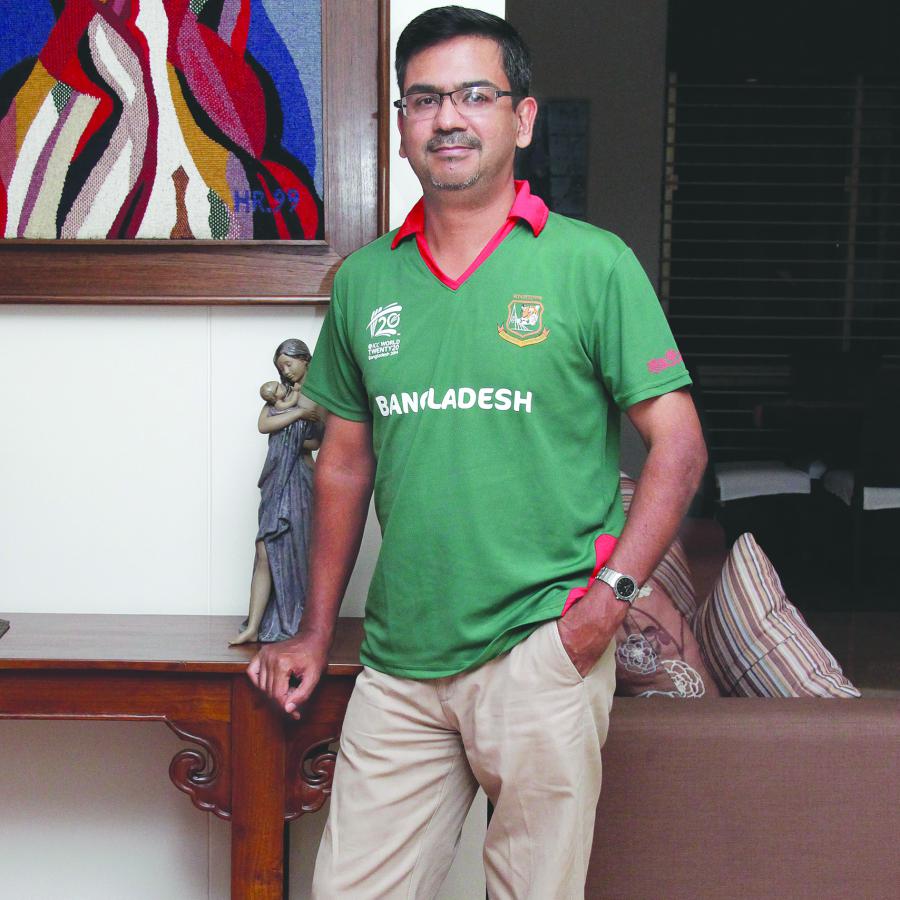
Decentralisation of power and continuously upgrading the skills of his people, are two other important steps Omar implemented in a well-thought-out move to ensure hassle-free and smooth functioning. Today, all his senior merchandisers are licensed to work independently devoid of any interference from the higherups. “The entire merchandising team has been with me from the very beginning and I have trained them over the years with outmost care wherein they have reached a stage where least intervention is required in the smooth functioning,” maintains Omar, underlining how it has resulted in quick and timely decision making; more so while dealing with the buyers where any wastage of time runs risk of losing out on sizeable business orders.
Keeping with the production volumes and its corresponding requirements, Syntex has brought about certain changes in the setup of its manufacturing unit. Unlike majority of factories in Bangladesh, Syntex has not departmentalised its operations. Its production unit has six floors, and all the floors are completely manufacturing units unto themselves with their individual knitting, link/trim/ mend, wash/dry/iron /PQC and packing facilities with separate managements to take care. Manufacturing half a million pieces of sweaters every month divided into 80-100 styles running simultaneously at any given point of time in the shop floor, Syntex has six production managers and separate in-charges for every section.
To keep his team abreast of new developments, Omar also encourages them to attend every possible training session and event. “I regularly send my merchandisers to seminars conducted by buyers both overseas and in Bangladesh to hone up their skills,” underlines the Group’s MD pointing out such exercises, besides skill upgradation, also help build better rapport with the buyers.
The whole new perspective that Omar brought to the table as an entrepreneur is a direct outcome of his earlier experiences dealing in family business of shipping, real estate and others, the best practices from which he put to good use in his new venture with great success. However, despite the achievements, Omar’s concern now is about the industry’s prospects in days to come. Especially in the light of infrastructure drawbacks coming in the way of expected growth projections, political instability and multi-agency compliance pre-requisites that have forced many to shift base to greener pastures like Ethiopia, a potent competitor, because of the African Growth and Opportunity Act (AGOA) allowing the subSaharan country duty-free market access to USA. “The treaty has already accounted for good number of investors giving Bangladesh a miss,” points out Omar.
“I am sceptical about the US $ 50 billion mark set by BGMEA. There is no doubt that Bangladesh does not have dearth of good entrepreneurs or skilled workforce, but there is a lot of business uncertainty due to political reasons and lack of infrastructure,” states Omar, who expects Government’s active support in making available land, ensuring regular and uninterrupted power and gas supplies, to achieve even a US $ 100 billion export mark.
Sounding somewhat unhappy, dwelling on certain recommendations of the roadmap prescribed by Accord and Alliance, Omar cites his own experience. “We had all our systems in place even before the Rana Plaza tragedy, which was a surprise for the Accord audit team that was more than impressed with our level of safety, security setup and preparedness. But recently the same group of auditors have come up with a whole new set of compliance requirements,” laments Omar, who feels the move is rather uncalled for, considering that his manufacturing unit had already been subjected to inspections by the buyers as well as Accord who were unable to find any lacking in its safety and security arrangements then.