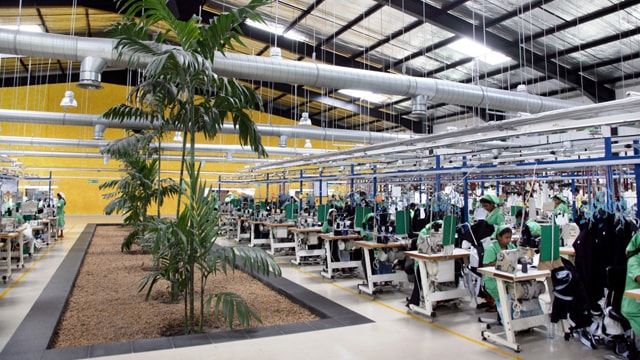
Even as vast majority of the garment manufacturers/exporters are struggling to make their business profitable in the face of diverse challenges, including rising labour costs and overheads, diminishing margins, market meltdowns, economic upheavals, to name a few, names like the Chittagong-based Habib Group are earnestly working on a well-planned strategy based on the pillars of sustainability and improved efficiency and productivity through technological interventions, to ensure a sustainable future.
The younger generation like me have entered business at a very challenging time… The Bangladesh apparel industry is presently undergoing a fire-fighting situation and the only way to tackle this situation is to be sustainable,” explains the young and suave Tanvir Habib, Managing Director of Hela Clothing BD Ltd. and Director of Legacy Fashion Ltd., Anowara Fashions Ltd., Siam’s Superior Ltd., spearheading the apparel division of the Group that clocked a turnover of around US $ 150 million last year. The two other production units of the Group are, namely Valiant Fashion Wear Ltd. and Anowara Apparels Ltd.
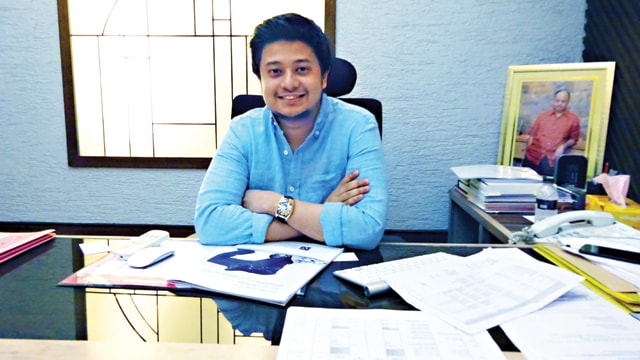
Established in 1947 as a trading company, Habib Group with its very own yarn, weaving, fabric dyeing, processing, washing and garmenting facilities and one of the leading business conglomerates in Bangladesh with interests in cement, steel, fertilizers, paper, aviation and power generation, has recently acquired a green facility namely Hela Clothing Bangladesh Limited while also working towards workplace remediation in the other units to make them sustainable. For Tanvir, bestowed with a futuristic vision, the advent of Accord and Alliance in the aftermath of the infamous Rana Plaza disaster is an opportunity to improve and excel rather than a hindrance, as is considered by many.
“We have not taken the measures mandated by Accord and Alliance towards achieving compliance negatively, instead we are continuously working towards it. If you sow a seed, it won’t grow into a tree in a day. If you consider the entire garment industry, it’s only about 80 per cent that could achieve complete remediation as per Accord’s standards and we want to be amongst the top,” declares Tanvir, confident of getting the thumbs up from Accord during the upcoming audits this month.
PRODUCTS
• Woven tops and bottoms for both men and women
• Production capacity is 1 million pcs. for tops and 1 million pcs. for bottoms per month
Investing in new technologies is another area Habib Group is working upon to improve quality and productivity while minimizing the wastage. It has recently bought some new machines (such as front loading washing machines and laser machines) for its washing section.
SUSTAINABILITY EFFORTS
• The company uses LED lights on its production floor to reduce electricity consumption
“The new machines will help reduce consumption of water and chemicals significantly,” maintains Tanvir, adding, “For us productivity does not mean increasing manpower or quantity, it has more to do with increasing the capacities with the existing manpower.”
BRANDS
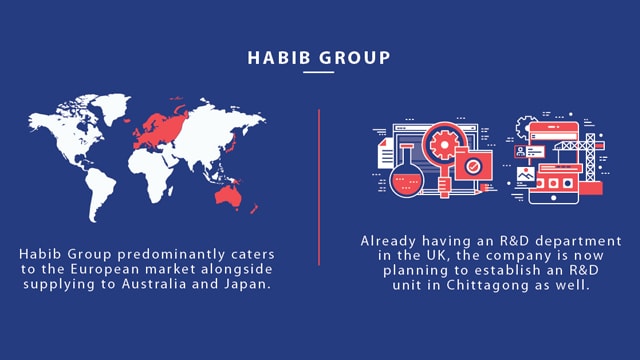
• The Group caters to global brands such as M&S, Walmart, H&M, Sainsbury’s, PVH, Calvin Klein, George and BIGW
Optimum utilization of manpower and efficiency improvement, not only through imbibing technology but also through management systems, are critical to sustaining growth in an organization and thus the company has invested heavily in IE to improve efficiency, reduce wastage, ensure optimal manpower utilization, line balancing, etc. In Chittagong, it is probably only one of the few factories which have succeeded in IE.”
FOB PRICES
• FOB prices range from US $ 5.5 to US $ 7
At the introduction phase of the IE, the company selected a sewing line making shirts and focused on improving the productivity. It invested in some automated machines, templates and taught workers the improved hand movements to rectify their motion which earlier took more time. The achieved results led to saving a minute in SAM in making of a shirt. The second step after the introduction of IE is to train the operators thoroughly to get adapted to the new methods, and Habib Group – which is concerned with the global economic recession resulting in huge dip in prices in European market – is planning to invest in Garment Sewing Data (GSD) software to ensure the same.
“The only way to cope with the existing scenario is to use machines that give more output with less manpower consumption,” says Tanvir (who has introduced automatic sewing machines to achieve this objective) winding up the conversation on an optimistic note.
Habib Group’s innovative ideas to increase efficiency
“Motivation is a powerful therapy that helps our operators to work soundly and more productively; and if idea is through fun and games, it has a long-term implication,” avers Tanvir. The HR department has taken the initiative to exercise mental therapy on operators who during their lunch hour are made to sing for few minutes. This eases the mental pressure on them to achieve the target in 8 hours and makes them more efficient.
Another innovative idea is the balloon game, where an inflated balloon is tied at the front of every production line. If one line achieves the production before the other, one of the operators runs to the other line and pricks the balloon. This competitive feeling amongst operators makes them work efficiently and achieve the target on time.