
Economy in Bangladesh seems to be on a recovery mode since businesses reopened on 31 May after almost 2 months of countrywide shutdown. The first case of COVID-19 was first detected somewhere in the early part of March, and by end of the month, the Government imposed a lockdown which virtually brought everything to a grinding halt, be it manufacturing or retail (except for the commerce).
Even though the Government allowed businesses to operate in May considering Ramadan and Eid-ul-Fitr, it was on a very limited scale and with strict restrictions, during which, shops were allowed to remain open to do business only on a limited scale. Shopping malls were even asked to make arrangements for hand washing and other safety requirements. However, with passing time, more and more restrictions were relaxed.
“All Miniso Bangladesh and Noir stores remained closed from 25 March 2020 and reopened on 10 July 2020. The health and well-being of our customers, colleagues and community are and will always be to be our top priority which is why we had opted to keep our gates closed during the peak seasons and resumed operations after taking the time to carefully implement strict safety protocols to ensure a comfortable and safe shopping environment,” Shah Rayeed Chowdury, Director, Evince Retail Limited, told Apparel Resources.
Also Read: Report underlines state of women workers in Bangladesh garment sector
However, unlike fashion retail, market for daily essentials and consumer goods made a turnaround in July, but sales reportedly plummeted by 10-15 per cent in August again.
Sales of clothing brands such as DehsiDosh, Western Fashion, Artisan, Cats Eye and Aarong were still down by 50 per cent than usual. “It will take more time to get back the sales of normal times,” said the manager at Western Fashion’s Bashundhara Shopping Mall outlet, while Shaheen Ahmed, President, Association of Fashion Designers of Bangladesh and the Owner of Anjans, said demand for new clothes has decreased with social events remaining suspended and people not going out much.
Footwear brands have also been going through a similar selling condition. They are not getting more than 60-65 per cent of buyers compared to the pre-pandemic times, said Md. Shamim Sheikh, Branch Manager, Apex, a leading footwear brand at Bashundhara Shopping Centre, while adding that traffic (customers) has been picking up to some extent for a week with customer flow now around 65 per cent.
So, compared to the initial days after markets reopened, the volume of customers has also increased and shopping malls and markets across the capital are starting to get back to their usual as employees are re-joining their workplaces.
“People are now visiting malls to buy necessary items. There are no window shoppers this time due to the pandemic, but business is starting to pick up,” MA Hannan Azad, President, Bashundhara City Shopping Mall Shop Owners Association, told the media, adding, “Close to 95 per cent sellers and employees have returned to their workplaces. Since early September, sales have also increased by 50 per cent.”
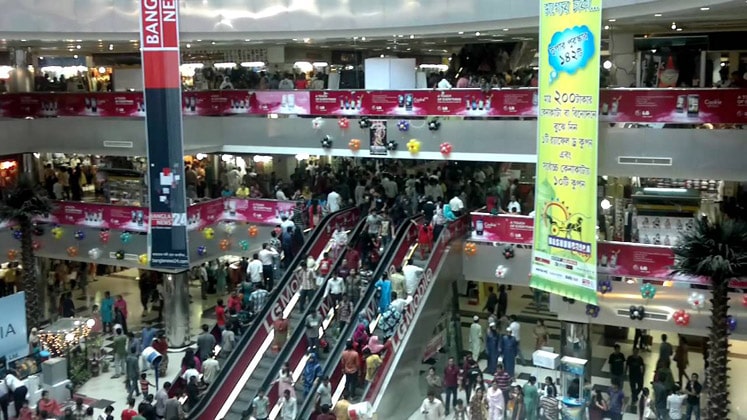
Most shop employees, reportedly, left for their villages and many even lost their jobs during the lockdown period, as many shop and store owners failed to pay their salaries regularly.
“Considering the health risk of employees and shoppers, our markets remained closed for a long time. The rentals for most shops were waived for 2 months due to lack of sales. But since we are a developing country, it is difficult to survive without work. Employees have, therefore, started working again and consumers are also beginning to visit markets,” maintained MA Hannan Azad.
“The pandemic has reduced my wages; earlier, the company used to hire two new sales executives ahead of Eid-ul-Fitr, but this time, only my colleague and I had to handle it and even customer turnout has been very low,” said a sales executive of the retail fashion brand Kay Kraft at Aziz Super Market, while adding that business has picked up recently after Kay Kraft, reportedly, started offering up to 50 per cent discount on its products to attract the customers.
Also Read: New initiative to help the pandemic-hit workers in Bangladesh
“Around 20-30 per cent shops remain closed and 10-15 per cent employees of the markets lost their jobs. We do not know how long the pandemic will remain. This damage may intensify in future. But now, we have to focus on picking up our sales,” stated Helal Uddin, President, Bangladesh Shop Owners Association, while Khalid Mahmood Khan, Founder, Kay Kraft, and an executive committee member of the Fashion Entrepreneurs Association of Bangladesh (FEAB), on his part, said, “As our sales are slow, it is difficult to sustain the business. Expenses such as shop rent and utility bills are huge. This is the time to keep everyone’s job safe instead of sacking. To deal with this crisis, we reduced the duty hours of our employees, so that they do not lose their jobs and can get at least minimum salaries.”
However, with visible signs of improvement, business is reportedly picking up in majority of shops and malls including Jamuna Future Park, Bashundhara City Shopping Mall, Mouchak Market, New Market and Police Plaza Concord, etc.
But with winters approaching fast, experts are apprehensive that there could be an increase in coronavirus cases in the country.
“I fear the situation may deteriorate in winter, as people, during that time, are used to suffer many other respiratory viruses and flu-like diseases,” underlined Prof. Nazrul Islam, former Vice Chancellor, Bangabandhu Sheikh Mujib Medical University (BSMMU), while adding that cooler temperatures and low humidity are likely to help coronavirus live longer, while vitamin D deficiency and weakened immunity may help the virus take a heavy toll on human health.
Echoing the same sentiments, Prof. Nazrul Islam, also a member of the National Technical Advisory Committee (NTAC), underlined that mortality rate is likely to go up, as COVID-19 may get stronger with influenza and pneumonia, asthma and other cold-related diseases during the winter season.
“We need to intensify our efforts to contain the virus as early as possible through effective programmes,” said Prof. Nazrul, while Prof. Benazir Ahmed, former Director (Disease Control), DGHS said though many experts have said that coronavirus has no relation with the weather, it has a correlation with the season for sure.
“The symptoms of the deadly virus are similar to cold-related diseases. It’s basically a disease of winter; it has many strains which are capable of surviving during any season like summer and rainy,” said Benazir Ahmed, while adding that there are some strains of coronavirus that may become acute and deadly during the winter.
“We should now work out plans so that we can tackle the virus effectively during the cold weather,” he cautioned.
Any second wave of the pandemic is definitely not going to augur well for the country, especially the manufacturing and retail sectors, which are slowly limping back to normalcy now.
“This is not the first time the business world has gone through forces that have shaken it. Take the example of the internet that put several companies out of business – those could not adapt to the new change. However, the internet has helped to create businesses in return as well. Another example is streaming. Streaming services wiped out all video store businesses. The ones that run out of business are the ones who cannot adapt. We have to learn to adapt to changing times and to new ways of running business. Of course, the COVID-19 pandemic was way more sudden and shocking than the internet, but the point I am trying to make is that it’s now new in business. What we are going through now, we have to view it not as the end, but as a part of the journey. On that note, there is no going back to normal or pre-COVID era; in the same manner, the world had changed after, let’s say, World War 2, there was no going back to what the world was like before that. In the long run, we do not know what will happen, but one thing is for certain that we will learn to adapt,” Shah Rayeed Chowdury (Director, Evince Retail Limited) summed up the long-term implications of the pandemic on the retail sector of Bangladesh, especially the fashion and lifestyle domains, albeit on a positive note.
Also Read: From slavery risk to selling assets to meet expenses – Impacts of COVID-19 on apparel workers