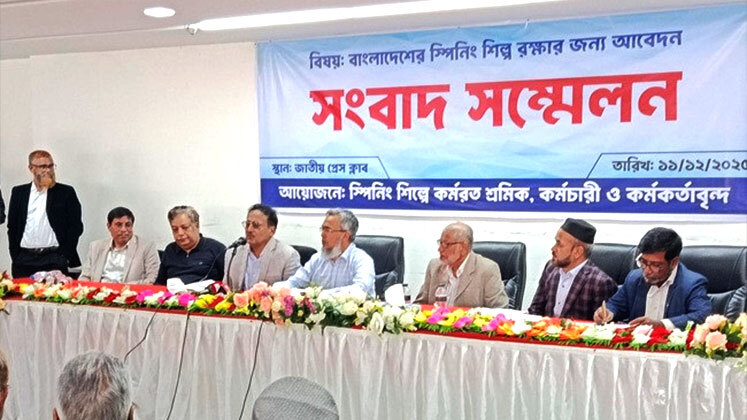
Leaders and representatives of Bangladesh’s spinning industry convened at the National Press Club on 11th December 2025 to issue a stark warning about the sector’s worsening condition and to call for immediate government support. Senior figures outlined mounting pressures on spinning mills, including escalating production costs, volatile cotton prices, weakening demand and growing competition from cheaper imported yarn.
Industry leaders stressed that the spinning sector remains the backbone of the country’s readymade garment (RMG) industry, converting raw cotton into yarn, supporting the export economy and employing millions of workers directly and indirectly. They noted that spinning mills have invested heavily in skilled labour and modern technologies to retain competitiveness in global markets.
However, the sector has been destabilised by a combination of global and domestic shocks, including the Covid-19 pandemic, the Russia-Ukraine conflict, persistent dollar shortages and energy supply challenges. These disruptions have pushed manufacturing costs sharply higher and eroded the competitiveness of locally produced yarn.
According to industry representatives, nearly 40% of spinning mills have already ceased operations, resulting in job losses for close to 100,000 workers and placing thousands more at risk. Remaining mills are described as operating on the brink of closure.
The leaders appealed for a series of urgent policy measures to prevent industry collapse and safeguard national economic stability. Key demands include restoring stronger export incentives for garment manufacturers who use locally produced yarn, specifically a 10% incentive, alongside a 10% safeguard duty on imported yarn to counter surging foreign competition. They also urged the government to provide a 30% rebate on gas and electricity for export-linked industries over the next two years, citing similar support schemes offered by competitor nations.
Furthermore, they called for stricter monitoring by the Ministry of Commerce and the introduction of anti-dumping or safeguard duties, arguing that imported yarn is often sold in Bangladesh below domestic production costs due to subsidies provided by exporting countries.
Industry leaders warned that without swift intervention, the sector could face widespread closures, jeopardising millions of livelihoods and threatening a critical pillar of Bangladesh’s export economy.