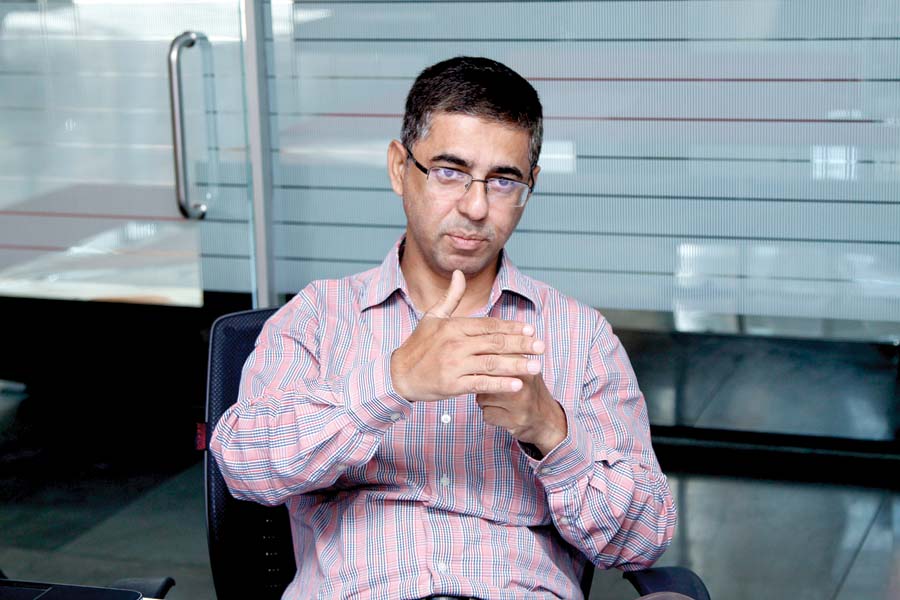
India has always been known for its handcraft and creativity, the two elements that have supported growth in the home fashion segment, but it has also restricted the reach and potential of the industry as few players have ventured beyond the obvious. With changing global equations, it has become imperative to develop new capabilities for future growth. Nafis Rahman, a GMT graduate from NIFT, who has over the years imbibed a deep understanding of the home segment, having travelled the journey from QA Manager to Group Leader at Triburg Home Division, shares with Apparel Online what will be the products in demand for the upcoming season, as also the fronts on which our home furnishing industry is losing out on, and why…
Sitting in the beautiful green building of Triburg, Udyog Vihar in Gurgaon, Nafis is very vocal on the fact that India has lost out to Pakistan and China in the home furnishing business, as they have an edge compared to India in areas like intimate blends, wider width processing/printing, lower thread counts, printed towels, curtains with more light observance, door mats with nylon to name a few. “Two years ago when our buyers asked us for products using intimate blends (blending of various yarn at spinning stage), I went to all the big companies but was unable to get it even though China and Pakistan were big on the segment; even today India is lacking on the same,” says Nafis. He adds that no one is investing in this segment as it requires a lot of R&D.
“Most of the Indian manufacturers don’t want to put extra efforts, even if it is quality as they are getting enough orders as well as value from domestic market and most don’t bother about extra opportunities of export.”
“We are doing well in towels, why can’t we do it in other categories of home textiles?” – Nafis Rahman
Sharing his experience, Nafis clears the reason also, “Big Indian exporters or manufacturers don’t want to get into intimate blends, as the export market has a comparatively limited demand for the same and that too from lower and lower-middle segment. Secondly, big exporters are already running to capacity and domestic players don’t have demand for this segment. It is sad that India is losing on this particular chunk of orders, which can add extra value in our business. Industry has to come forward and invest in newer areas to get extra orders and share of business, which is currently going to other countries,” deliberates Nafis.

Another area that India is losing out on is wider width processing as there are very few units doing it especially for export market. Wide width process is however available in a traditional way in Jaipur and Jodhpur, but coming to rotary and zimmer, it is very limited and even their quality and rates is not as good compared to China and Pakistan. “Most of the Indian manufacturers don’t want to put extra efforts, even if it is quality as they are getting enough orders as well as value from domestic market and most don’t bother about extra opportunities of export,” argues Nafis. Even wider width digital printing is still not seen too much in India and this is something that can pick up very well because one can have very large repeat sizes translated into printing.
Triburg expecting good growth in home segment
Expecting very good growth in home segment soft goods, covering all products from bedding, kitchen, curtain, and flooring account for 70 per cent of the home business at Triburg, out of which towels are a small segment. The buying office, working with 20 vendors from across the country, has many suppliers who are very flexible in their product offerings. Being an apparel-driven buying agency, it has applied many of the standard parameters in quality to the home segment also. Like it generates standard operating procedure (SOP) for home furnishing suppliers, it helps in vendor’s quality, productivity as well as in delivery even without asking them to invest much in technology; most suppliers have improved a lot just by standardizing operations and processors. Developing an SOP in an unorganized industry was a big challenge but it gave very enthusiastic result and it surprised the buyers also.
It is not as if no one is exploring these opportunities or investing for the same but such companies are very few and far apart, and that is a major concern. “We are doing well in towels, why can’t we do it in other categories of home textiles?” questions Nafis. Even the use of technology is limited with very few companies in home furnishing segment using hanger system, industrial engineering and offering a lot of flexibility in terms of buyer’s demand. Most of the small- or medium-level players don’t normally have vertical integrated set-ups, but have edge in value addition and are good in design. “I know of one design based factory, which created quilting after foil printing on velvet. Now it is up to them how they market it, like organza fabric which is actually a cheap fabric compared to other fabrics but it fetches very high value and good orders, because of the perception of being value. In this way, be it a small or big set-up, one has to create a niche, which really matters,” reasons Nafis.
As a long-term solution, Nafis suggests the need to bring in change with greater emphasis on training, as 80 per cent value in home furnishing segment comes from yarn processing, weaving techniques while rest 20 per cent is surface ornamentation. “Combination of techno management courses (as offered by NIFT) along with deep knowledge of processing; weaving (being offered by textile institutes) will take the home textile industry to next level,” argues Nafis.
Fulfilment of testing norms is again a big challenge for the Indian home textile industry, and according to Nafis it is just a matter of attitude. “In areas like Karur which have traditional ways of working, only a few players are able to meet all testing parameters. Today all chemicals come with expected colour fastness and we know what we are going to achieve through this particular product, so knowingly if one is not following procedures it is a matter of attitude. Further, most of the processing is outsourced and one does not have the control over this, so integration of processing is also required,” he adds.
As far as the coming seasons are concerned, Nafis feels that higher thread count sheeting business will see little more growth in coming days compared to other products, as now a lot of customers are looking at India for value added bedding. “One should marry printing with some more value additions as lot of customers are going for prints now but they cannot afford just plain prints and this combination might see a big growth,” concludes Nafis.