One of the most important jobs of any industrial engineer is work study. This implies firstly, to estimate the work content of an operation through time study, and secondly, to explore potential for improvement through motion study, i.e. how to reduce the work content of the operation. The estimation of work content is relatively easy if one practices Predetermined Motion Time Systems (PMTS) exploring improvement potentials. This involves conducting motion study, preparing a two-handed process chart, identifying unwanted motions and/or idle situations, and suggesting modifications in motion sequence. Although this job looks simple, but it is the most difficult and rarely a capable person is found to do it. On the other hand, time study is not so difficult but cumbersome. The young generation of industrial engineers today do not have the patience and temperament to conduct the time study the same way as it is supposed to be done. A team from the Department of Fashion Technology at NIFT New Delhi, comprising of Professor Prabir Jana; Asst. Professor Deepak Panghal; and Amandeep Singh, a student of Masters in Fashion Technology discuss smart way of conducting motion and time study, which is both more interesting and realistic.
Although video based time study is popular nowadays, this only converts the ‘stand-up’ mode of data collection in a sweaty shopfloor to ‘mouse click’ mode of operation in an air-conditioned desk job. However, the same method can also be employed comparatively in a much smarter way to conduct motion and time study, wherein the computerized system is used to capture and analyze time study data of sewing operation and video analysis of hand motion to predict the improvement potentials in most realistic, if not the most accurate way.

Traditional Work Study
Today, most of the manufacturing organizations use SAM or SMV as work content of sewing operations, while some actually conduct a time study of the multiple operational cycles and calculate SAM or SMV, adding allowances. The practice of applying the rating factor is completely ignored. Those organizations, which do try to use the PMTS data, actually use some existing database adjusted to organizational requirements by some hypothetical efficiency factors. The motion study is never done as the objective is always to set the target and not improve of the existing method of working really, because of which the improve essence motion and time study is lost with organizations merely trying to document and do what was or is being done.
Why are Traditional Motion and Time Study considered cumbersome and boring?
“Why we require to breakdown an operation to 10/15 micro element and calculate time taken for each and every element? We can simply breakdown any operation to four macro categories: loading time; needle running time during sewing; handling time during sewing; and unloading time. Based on these of four categories of time we can decide where to focus on, whether needle running time needs improvement or loading and unloading time taking more time and so on”. – Dr. Prabir Jana
Although the organizations embraced IT in different activities of manufacturing, time and motion study is still done in the most archaic way. Motion study involves identifying and documenting 18 distinct types of motions in a sewing operation (SIMO chart) or making two-handed process chart by classifying hand movements into four categories, namely operation, transport, delay and hold. This is probably the most challenging task and requires knowledge of industrial engineering and PMTS specifically, preparing right and left hand chart for an operation of 1½ minutes cycle time can take nearly 1½ hours. Despite the fact that video recording of operations are done nowadays, rarely any motion analysis software is used for analysing those videos.
Time study is conducted by a stopwatch (often a non-decimal one!), a non-ergonomically designed board and paper format to fill up data. For conducting time study of a sewing operation of 1.0 min of cycle time, a time study operator has to stand on shopfloor in front of that operation for minimum 40 minutes to collect the data for 30 cycles, another 20 minutes for entering the data in spread sheet and calculating the SAM with rating factor and all allowances already fed in. On an average, in a garment with 25 operations with 60 minutes per sewing operation time, it will take 25 hours to arrive at SAM value. And most importantly, in these 25 hours of work there is no use of intellect, they are simply cumbersome and boring! Even when the technology options are used like electronic stopwatch, integrated time study board or video time study technique, time spent for data collection remains same, only attention span and reflex requirement is lesser, moreover additional analysis time is required for element breakdown of operation (although this can be a desk job in an air conditioned cabin), and calculation is error-free. It is important to note that technology enabled option is also equally cumbersome and boring, according to the young generation of industrial engineers.
A real time sewing speed monitoring system captures the data at every second (or at any predetermined time gap). The data is analyzed to calculate four categories of time, namely loading time, sewing time, handling time during sewing, and unloading time automatically.
Additionally, rating is one of the most important factors to be considered while calculating SAM from observed timing. Rating of operator is to be done to assess operator’s rhythm, two hand co-ordination, speed and pace of work, unnecessary motions, etc. and requires an experienced work study engineer (may or may not be from the apparel industry). Invariably the rating aspect is ignored in all the calculations, as we simply do not have expertise to do so.
What is Smart Motion & Time Study?
A real time sewing speed monitoring system captures the data at every second (or at any predetermined time gap). The data is analyzed to calculate four categories of time, namely loading time, sewing time, handling time during sewing, and unloading time automatically. As the computerized system collects the sewing speed automatically from sewing machine in a non-evasive manner, the time study engineer need not stand in front of the operation, rather data from multiple operations from multiple machines can be collected simultaneously. The operation is neither broken down into small element nor is element wise time recorded or calculated.
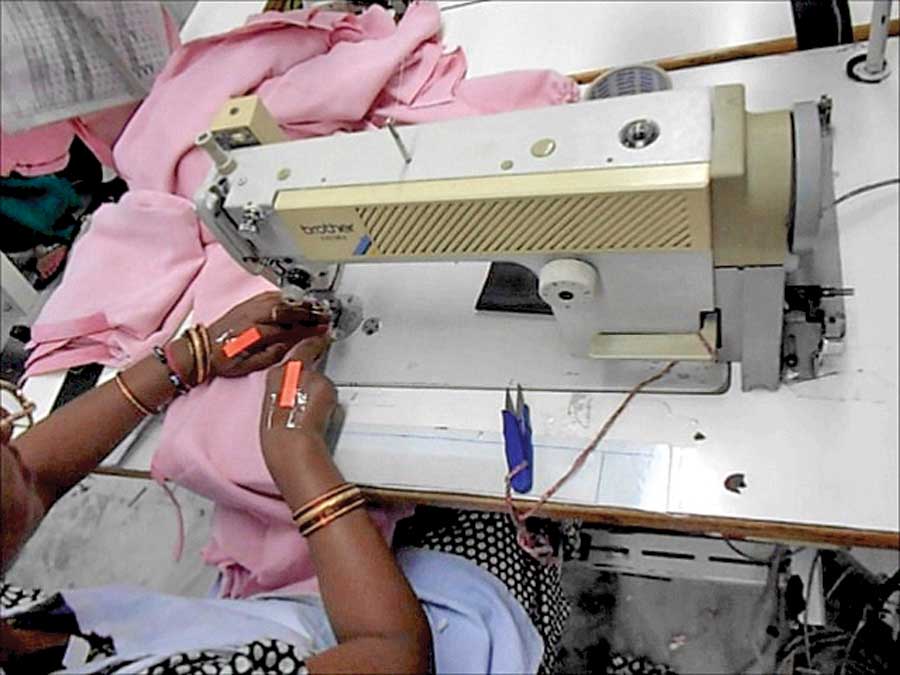
While the real time sewing speed monitoring system captures the data from the sewing machine, simultaneous video recording of the operation is done by placing a tracking marker in different parts of moving body parts (a simple bright coloured 3M Scotch tape can be used as tracking marker). The video is then further analyzed to calculate the distance travelled by hand parts (e.g. tracking wrist and forearm movement is possible separately), angle of movement and pace of movement of hand by any motion analysis software. There are many open source software available free of cost. This motion analysis technique is simple, but effective and the operator does not require any IE expertise!
An Experimental Analysis
An experiment was conducted in two factories with 1200 sewing cycles. Eight different sewing operations were selected; each sewing operation was done by five operators of different skill levels and 30 cycles each. Some of the findings are as under:
• The current understanding of 20:80 ratio of sewing to non-sewing time in any sewing cycle is questionable! Sewing operations rather should be divided into two categories; sewing with one component (‘A’ type) and sewing with more than one component (‘B’ type). While ‘B’ type sewing operations follow current characteristics, the characteristics of ‘A’ type sewing operations is yet to be correctly understood.
• The ratio of sewing to non-sewing time in ‘A’ type sewing operations can be 42:58 and that for ‘B’ type can be 26:74. In ‘B’ type operation, the operator normally runs the machine at lower RPM, and in ‘A’ type operations, the operator can achieve 50% higher RPM on average.
• The work content was divided into only three categories: loading & unloading time; needle running time; and handling during sewing time. The ratio of same for ‘A’ type operation was found to be 30:42:28 and for ‘B’ type 38:25:37. Improvement potential in these three categories should be separately explored based on type of operation, organizational priority and operator skill availability.
Advantages of Smart Work Study

In traditional time study, the engineer stands in front of sewing operator; so the operator is likely to feel uneasy, resulting in unforced errors, change (knowingly or unknowingly) of pace, etc. in smart time study technique multiple sewing machines are just connected to the system by wires and operators continue to work as it is.
The smart motion study through video analysis is many times faster than traditional right hand-left hand chart, and also addresses the key parameters like amount of hand movement during sewing, pace of hand movement and angle of movement. Apart from numerical data, computer analysis can actually create a cloud picture of hand movement to compare with normal and maximum span and explore improvement potentials.
Conclusion
The essence of Smart Work Study is to concentrate on macro factors rather than micro details. The young ‘Y’ generation is the manpower in the coming decade; we need to find means and methods to engage them in the most fruitful manner. Changes are taking place everywhere; social networking phenomenon not only invaded (disturbed/elevated) private life, but it has entered the field of education as well as corporate work life.
Why not change the way we think and develop newer ways of work study to reach the desired goals.