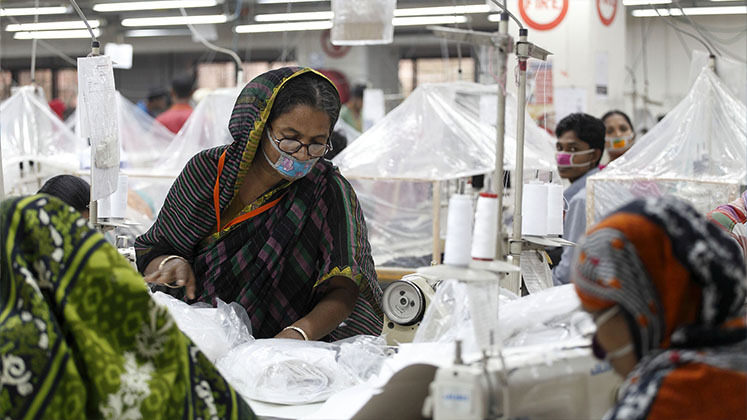
Rising temperatures are already reducing worker productivity in Bangladesh’s textile factories, with new research warning that worsening heat stress poses a growing threat to the sector’s stability.
The study, Global Value Chains and Climate Change Governance: Garment Producers’ Futures, identifies excessive workplace heat as a major barrier to social upgrading. Conducted by Mohammad Harunur Rashid Bhuyan, Senior Research Fellow at the Bangladesh Institute of Development Studies (BIDS), and Rachel Alexander, the findings were presented at a session of the Annual BIDS Conference on Development in Dhaka.
The research highlights that an increasing number of climate-displaced individuals are entering the apparel workforce. As their numbers rise, more migrants may join the labour pool—an influx the study warns could depress wage levels.
Climate-related stressors were also found to heighten socioeconomic vulnerability, with the report cautioning that declining productivity may exacerbate risks of gender-based violence and workplace harassment.
The global apparel industry is responsible for an estimated 1.025 billion to 3.29 billion tonnes of CO₂e emissions—equivalent to between 2% and 7% of worldwide greenhouse gas output. Fossil-fuel-based energy remains the dominant emissions source in garment manufacturing. The study further notes that pesticides and fertilisers used in cotton cultivation, alongside emissions from polyester production, significantly contribute to the industry’s climate footprint. Heating, ventilation, air-conditioning systems, production lines and sewing operations also generate substantial emissions.
Bangladesh’s Industry Policy 2022 promotes cleaner industrial practices by encouraging the use of effluent treatment plants, central ETPs and support mechanisms for factories adopting clean development measures to reduce greenhouse gases.
Despite these policy efforts, the study finds that producers continue to battle high costs, limited access to finance, technological constraints and a lack of information and appropriate equipment—challenges that hinder meaningful progress in climate-resilient manufacturing.