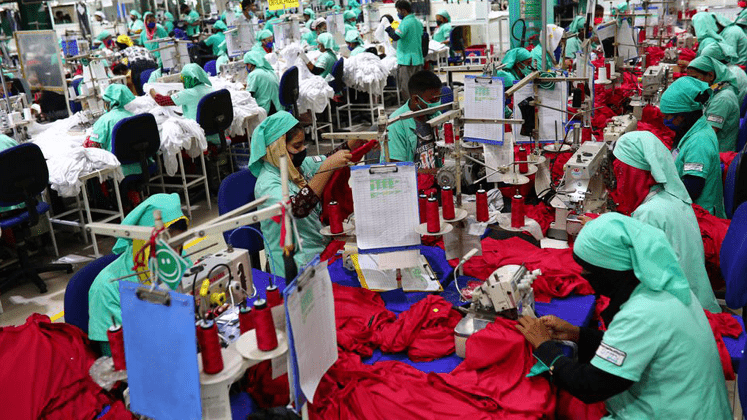
That Bangladesh has made tremendous progress in sustainable garment manufacturing is a well-known fact. Today, the country boasts of the highest number of LEED green factories.
“We have now 138 LEED green factories of which 35 are platinum rated. Thirty-nine of the global top 100 LEED green factories are in Bangladesh and around 500 factories are in the pipeline. So, Bangladesh is showing its maximum commitment when it comes to sustainability…,” underlines the newly-elected President of the Bangladesh Garment Manufacturers and Exporters Association (BGMEA) Faruque Hassan, speaking to the media.
Thanks to the various efforts and interventions by the stakeholders, Bangladesh’s textile and garment sector has significantly cut water and energy consumption by adopting low-cost and cleaner production processes and installing new technologies and, one such effort is under a programme initiated by the International Finance Corporation (IFC).
According to reports, some 338 washing, dyeing, spinning, weaving, and garment factories are saving 28.7 billion litres of water a year by adopting the solutions of the Partnership for Cleaner Textile (PaCT), a flagship programme of the private sector lending arm of the World Bank Group.
Similarly, the factories are saving 2.9 million megawatt-hours (MGh) of electricity annually and avoiding 558,391 tonnes of carbon emission, according to data from the PaCT even as under the PaCT-2 programme, the mills and factories slashed wastewater discharge by 24.1 billion litres while participating mills and factories have invested around US $ 44 million for the purpose.
Investment of a single US dollar can cut the consumption of 26 cubic metres of water, avoid 0.2 tonnes of greenhouse gas (GHG) emission, save two MWhs power, and reduce wastewater discharge by 23 cubic metres a year with the adoption of technologies, said the PaCT.
“We are using technologies to save energy in collaboration with our retailers and brands and PaCT experts. We are saving a substantial amount of energy and water,” said Mohammed Al Tauhidul Islam, Assistant General Manager of the sustainability department of Envoy Textile Limited, which used around 60.47 litres of water to produce one kilogramme of denim fabrics in 2016 even if the water used has gone down to 44.9 litres thanks to the installation of the full-water metering technology in collaboration with the PaCT, which has cut water consumption for processing fabrics as it can process one kilogramme of denim fabrics using 55.63 litres of water, which was 85.76 litres earlier.
The Bhaluka-based factory has targeted to reduce water consumption by 34.91 per cent by 2021 compared to 2016 even as Envoy Textile has so far cut water consumption by 25.7 per cent, and the rate will go up by the end of the year, underlined the Assistant General Manager of the sustainability department even as the company has drawn a roadmap covering five to seven years to reduce water and energy consumption and use the heat of gas boilers while Urmi Group, another garment exporter, currently consumes 60 litres of water to dye one kilogramme knit fabrics, way down from 100 litres to 105 litres needed two years ago.
“I have a target to bring down water consumption to 40 litres by next one and a half years as I have been upgrading technologies,” underlined Asif Ashraf, Managing Director of the group.
It may be mentioned here that launched in 2013, the PaCT supports the entire textile value chain – spinning, weaving, wet processing and garment factories — in adopting cleaner production practices as it focuses on reducing the environmental impact and resource consumption.
Meanwhile, gas heat recovery has become the name of the game for efficiency in the textile and garment sector to remain competitive in business and for a green transformation to save the environment even as majority of the big spinning, dyeing, washing and weaving mills have adopted new heat recovery technologies to utilise waste heat energy from gas burners installed to run the factories.
Previously, the burner exhausts used to be released in the air but now the millers capture it to boil water and run air conditioning and other purposes for which they can save both energy and money even as the waste heat recovery system offers textile units an economic and green solution to save valuable energy as the system extracts and reuses waste energy from industrial processes instead of dissipating it into the environment, according to the PaCT.
“By using exhaust gas boilers, we have reduced natural gas consumption and increased engine’s overall performance and annual savings of US $ 1.04 million,” reportedly claimed MA Jabbar, Managing Director of DBL Group, while adding, “I regularly review our energy efficiency level every month for further improvement to save the environment and also continuation of production.”
Jabbar has further plans on solar energy accounting for 10 per cent of the group’s power consumption — the DBL’s 90 MW natural gas engine’s current efficiency is 56 per cent and it is working on the heat recovery to increase it to 61 per cent — by 2025 even as A Matin Chowdhury, Managing Director of Malek Spinning Mills underlined that one of the processes involve converting the exhaust fuel into steam which is fed into a turbine to produce electricity.
However, these steam turbines can only convert 35 per cent of the steam into electricity, he said.
Wherever the industry uses captive power units, steam can be additionally generated for various other uses, such as for chillers, dyeing and availing hot water, which would have otherwise required consuming additional gas, said A Matin Chowdhury, adding the overall gas consumption in such industries attains efficiencies of 81 per cent to 86 per cent and went on to add that where combined cycle power plants are run, the efficiency is higher, at 47 per cent to 52 per cent.
The Managing Director of Malek Spinning Mills further stated that the company has been making savings capturing waste heat energy from gas usage in his three units including Knit Asia, Salek Textile and JM Fabrics at Shafipur in Gazipur while he produces around 50 tonnes of fabrics a day to produce garment items at Knit Asia.
Similraly, Md Anarul Islam Sarker, Deputy General Manager for utility and maintenance at Fakir Apparels, operates four natural gas-fired generators to run facilities even as the generators emit large volumes of exhaust gases at high temperatures, which the company is utilising to run boilers and produce steam for garment ironing, dyeing and finishing units.
As per reports, the waste heat recovery system has significantly reduced the company’s energy and boiler fuel demand by 27,456 kWh/year and 2,595,840 m3/year, respectively even as the factory is said to be enjoying around US $ 208,615 in annual savings from waste heat recovery, on which it invested US $ 177,000, Md Anarul Islam Sarker claimed.